One of our eight senses is interoception — the awareness of signals from inside your body, like hunger, thirst, breath, heartbeats, and fullness. This sense helps you care for yourself, regulate emotions, and respond to your body’s needs.
Here in the Northland, June arrives with longer days and warmer sun. Flowers bloom, the grass is green, rivers run freely, and the air carries new scents and sounds. Our bodies notice the change: the warmth of the sun’s rays on our skin, the pull of daylight, the rhythm of our heartbeat during movement. When we intentionally check in with these inner signals — pausing to feel our breath, noticing when we feel tired or energized — we give our nervous system guidance and balance after months of winter stillness.
This June, discover your interoception by turning inward. Your nervous system is adapting to growth and expansion — and mindful attention to your body’s signals can help you move with ease and vitality through the month
What other muscles get activated during the fight or flight response?
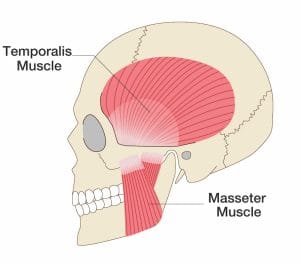
In April’s newsletter, I discussed how the psoas muscle tightens during a fight or flight response as protection and a way to escape. This month, I’d like to discuss how the masseter and temporalis muscles can also become active during a stress response. Have you ever caught yourself clenching your teeth together during a stressful event. The masseter and temporalis act together to bring the teeth together. This function is for chewing food. However, this action can become a habit in response to stress.
The over-activation of these muscles can cause: Tension headaches, especially at the temples Jaw/TMJ pain Teeth wearing Painful chewing Jaw locking or cracking.
At Halcyon house, we have several treatments that can help with this including:
Nervous system regulation/awareness: noticing when we are clenching
Relaxation techniques: learning to relax the body to reduce overall tension
Breathing practice: optimal breathing promotes a calmer/less reactive nervous system
Acupuncture: fascial acupuncture points
Massage: myofascial release of tension patterns in muscles and fascia
Craniosacral therapy: nervous system regulation
Neuromuscular re-education: establishing optimal use of these muscles, both contracting and relaxing.
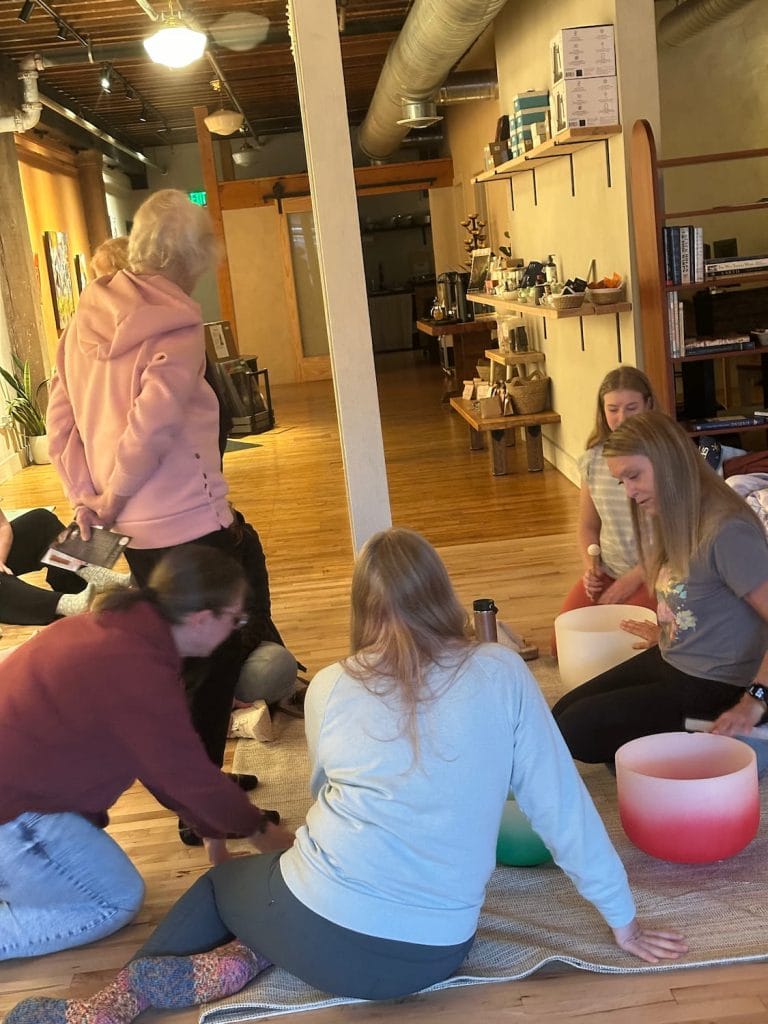
How did my journey to finding sound meditation begin? Along the way, through my journey in life, I’ve always been what most people would consider a “woo girl,” where I’ve always had an interest in topics and ways of living that are outside of the mainstream.
I have been interested in conciousness, life after death, spiritual healing, and topics that were not mainstream, period. I have learned, and reflected back, that I learn in life through feeling and listening and observing.
The health crisis that started my journey
I found myself in my own health crisis in 2011 with Ramsay Hunt syndrome. It left me with a lot of severe nerve damage including damage to my brain. It left me with a lot of pain which no pharmaceutical drugs would alleviate.
So I started to look for alternative forms of healing. I found my way to several different forms of sound meditation and sound frequencies. Through trial and error, and by going to others to receive sound baths and sound frequencies, I began to notice how the pain in my head slowly started to diminish. I was able to be put into a state of deep meditative relaxation that was so profound and so healing to me that words cannot articulate it. I still have a hard time putting my experience into words.
Different experiences for everyone
Everybody has such different experiences with sound frequency and vibration. For me, it is like my soul is being pulled to it. It is as if, even though it may not make sense to me on the outside, it is just something that I know makes sense.
The journey has been a long one to come out in the open and play the sound bowls and utilize the frequencies of sound with other people. Eventually I realized that I wanted to practice for others. In playing for groups, I continued my own inner healing. Throughout the next several years, I would have family and friends participate, and I would always receive positive feedback. My hope is that others receive a form of support and healing that supports mind, body, and soul. It is something that wants to come out of me.
I connect very deeply with the energy in the room and with who is around me. I intuitively connect with the bowls and play what needs to be played.
My shiatsu training is on hold this summer. I am hoping to take a week in December for the class. Sometimes life moves you in a different direction and that’s ok. On the brightside, this means I will have more time to enjoy summer and play in my garden.
Digging into Hypermobile Ehlers-Danlos Syndrome (hEDS)
Anyone who knows me at all knows that I am always researching and trying to understand how the body works (or doesn’t). Lately I have been diving deep into understanding Hypermobile Ehlers-Danlos Syndrome (hEDS) and Hypermobility Spectrum Disorder (HSD). So many of my clients are presenting with some form of this that I wanted to make sure that I was doing the right type of body work and have a deeper understanding about what is going on physiologically. EDS is complex and has 13 different subtypes making symptoms varied and diagnosis complicated. Anyways, I am still waist deep in data and unpacking all of this information and as always looking for a window of understanding and treatment that is holistic and addresses the root cause(s) of this common malady. I’ll consider this a Part 1 of … on this topic!
Did you know your brain can feel your body’s position?
Continuing my theme of our sensory experience, another of our eight senses is a sense called Proprioception. This is the sense that tells us where our body is in space, how our muscles are working, helps us with our posture and assists in how we move through the world. It helps us feel grounded to the earth, coordinated and connected to ourselves.
Sensing Spring
Here in the Northland, May brings the promise of newness. Green grass pushes up through the ground. Birds have returned and we wait for the bees to wake. The world is alive with subtle movement and our bodies are waking with it. When we intentionally notice our body position- bending, stretching, reaching and carrying-we connect more to ourselves after winter’s stillness. Even simple actions like balancing on uneven ground, or lifting your face to the sun tune your proprioceptive sense and invite steadiness.
This month, position yourself with intention. Your nervous system in learning to trust expansion and growth-and mindful awareness of your body’s positions can help you step into the season fully.
But what do I know?
My passion as an occupational therapist in Duluth is helping people to understand how they sense their environment, their body, and their emotions and how they process those signals. When we are either having difficulty sensing any of those things or having difficulty processing what we are going through, it can be uncomfortable (as we all know). I’m here to help educate and work with you towards better well-being!
This is a time for renewal, growth and awakening. In Traditional Chinese Medicine (TCM) the Liver governs smooth flow of energy throughout the body. If it gets out of balance you might experience:
Tension in the form of headaches, eye issues, jaw tightness, neck tension.
Emotions might come through as increased irritability, frustration, struggles with sleep and feeling stuck.
Digestion issues with increased bloating, indigestion and gas.
Spring is a good time to clear out energy that no longer serves you:
Clear out physical clutter, organize one area of your house that always seems a mess.
Mental clutter that might be ready to be released, fears and stories you might tell yourself that no longer serve you, limitations you placed on yourself you might be ready to push through.
Set digital boundaries for yourself, prioritizing more time outdoors, taking in fresh air and allowing your bare feet to touch the earth.
Create a list of what you were grateful for from this past season
TCM and Acupuncture in Duluth, MN
I’m always interested in talking about nutrition as it pertains to Traditional Chinese Medicine. Check out my other blog posts for recipes!
In the practice of Zen Shiatsu, the founder Shizuto Masunaga was very adamant about reading the Ki and rebalancing it using a “mother” hand that is listening and a “son” hand that is working.
The technique
I have been practicing massage using that concept for over 20 years (10 years of practicing massage in Duluth MN) and am still humbled by the power of this simple technique; one hand listens to what the body is saying, the other is creating a change. Recently, I have been practicing this technique with the Zen Shiatsu Bladder Meridian Channel along the spine all the way down to the little toe. My mother hand listens from one of the points along the thoracic spine while my son hand works the meridian until I feel the Ki moving under my mother hand. This has produced surprising changes in some clients. I wasn’t sure why this meridian was so universally powerful until a conversation I had with Jakki, our Acupuncturist, sparked a connection.
The meridian
Traditional Chinese Medicine (TCM) has mapped Shu points along the Urinary Bladder (UB) meridian. These points interact with each of the other 11 meridians. Balancing the Shu points can have a systematic effect on the body. What I had picked up through intuition and listening has a long history of knowledge and treatment.
I don’t claim to have this knowledge, I am still in discovery mode. Next summer I am diving deeper into TCM education with the distance program at the Zen Shiatsu school in Evanston, IL. This Summer I am taking the Beginning Zen Shiatsu class to brush up on my Shiatsu knowledge. I am excited to bring my practice back full circle to my first love of massage which is Zen Shiatsu. This time with 20 years of massage experience behind my touch. If you or someone you know is interested in doing this program at the same time please reach out to me! I would love (a) study partner(s). The Beginner Shiatsu Class is open to everyone with no prior massage experience necessary. I am doing the July intensive. https://zenshiatsu.edu/ce/beginning_zen_shiatsu/
Sara and I were invited to present at Svalja Whole-being’s Community Conference in Duluth. We are so excited to explore “body as place”. We will experiment with what makes you feel at home and safe in your body.
The conference starts Friday 5/29 from 6:00-9:00pm and continues 5/30 from 8:00-6:00.
Flourish is an invitation to ground ourselves in the wisdom of this place while leaning into the possibilities of what we can create together. From a soulful Friday night of live music and poetry at SOLCA to a Saturday filled with movement, guided storytelling, and deep reflection, this gathering is designed to nourish your nervous system and spark your creative spirit.
Throughout the weekend, experience a curated Art and Poetry Exhibit coordinated by Savannah Ottillia, offering a visual and written landscape of our shared journey.
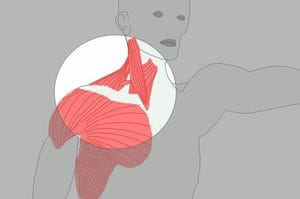
These are muscles that activate when we are in a sympathetic reaction (fight or flight). This can be in reaction to something in our environment that doesn’t feel safe, something happening internally (a physical stressor) or in our mind (stress).
One of these muscles is the Psoas. This muscle does several actions that support us in fight or flight. It helps lift our knees up to run (flight) or defends our core (fight). If these muscles activate and then turn off again, we might not feel any consequences. It’s when these muscles turn on and stay on that we will notice symptoms. These could include hip pain, back pain, restricted breathing, fatigue and nervous system dysregulation (anxiousness, depression).
The tightness of the psoas muscle will also be increased with prolonged sitting.
The Halcyon House staff have many practices/treatments that will support you in releasing tension in the psoas: